Self-help books to read in 2024

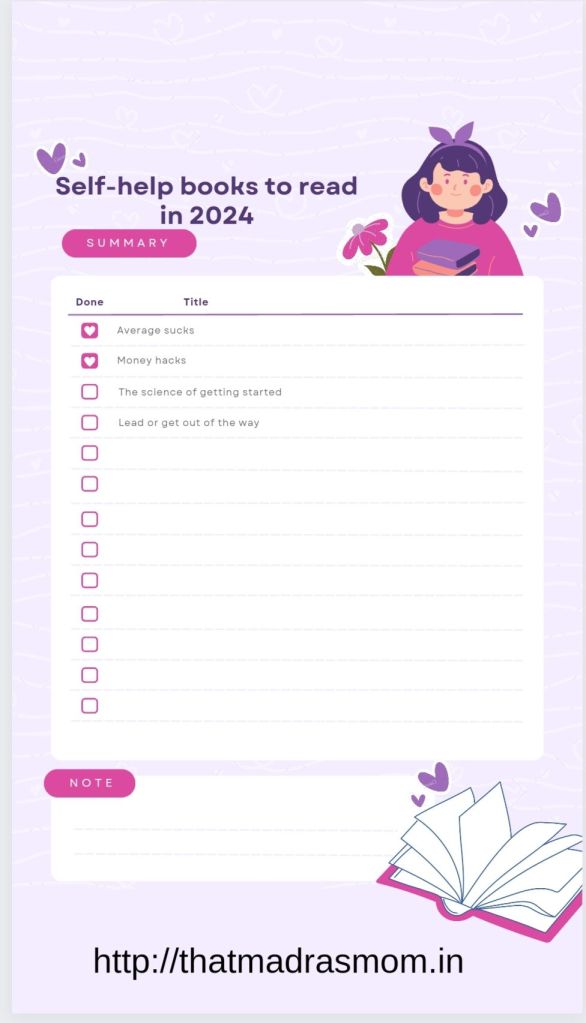
Self-help has always been one genre that keeps me glued while reading. I look forward to books that have a tone that is practical and not something preachy. I choose books which have a good amount of examples, case studies and research based evidence which is a sign that the book needs to be added to my TBR. Here are a few books that made it to my reading list.

Average sucks by Michael Bernoff

A book that challenges you to come out of your comfort zone and unleash your true potential. The reason we don’t get what we want is that we have an average that defines the behavior, performance, and results. This is the reason that the book argues. Our average is the invisible force that keeps us stuck in mediocrity and prevents us from achieving our goals. It shows how to identify our average, raise it, and surpass it so that we create an extraordinary life.
It is not a typical self-help that gives generic advice but rather a powerful guide that teaches how to change mindset, habits, and actions. The author has used these tools and techniques with thousands of clients.

The book has three sections such as
PART 1: The problem– Explain what your average is. How it affects you and why it hurts.
PART 2: The solution– reveals the five steps to raising your average and creating a lasting change.
PART 3: The action– provides exercises, challenges, and resources to help in implementing the solution and transforming your life.


A suitable book for anyone who wants to improve any area in their life- personal, professional, and social. I realized how my average was holding me back from achieving my dreams. I found a lot of tools and strategies to raise my average to create more happiness and success. A good guide that teaches you how to live an above-average life.Read a short review here. Buy a copy.

Money hacks by Larry Steinhouse

A book that reveals the secrets of money and how to use it to your advantage, it also challenges the common myths and misconceptions about money. The book shows you how to think differently and creatively based on your financial solution. I loved the topics that the book covered such as,

  • How to obtain huge lines of credit while building up credit scores and your net worth.
  • How to negotiate better deals and save money on everything you buy.
  • How to avoid pitfalls and traps of debt, taxes, and inflation.
  • How to develop a money mindset that attracts wealth and abundance.


The book is written in a simple, conversational, and humorous style with stories, tips, and real-life examples from the author’s own experience as a successful real investor and entrepreneur. The book is suitable for anyone who wants to learn more about money and how to make it work for them. It is not a get-rich scheme but a realistic guide that teaches the skills and strategies you need to achieve your financial goals. The book opened my eyes to the possibilities and opportunities that money can offer and how I can use it to create more happiness and security in my life.


I found a lot of tools and techniques that can be applied to my situation. A realistic guide which can help anyone understand the truth about money and how to use it smartly. Read a short review here. Buy a copy.

The Science of getting started by Patrick King

A book that explores the psychological and biological reasons why we procrastinate and how to overcome them. It reveals the hidden forces that prevent you from taking action such as perfectionism, fear, impulsiveness, self-doubt, and boredom. It also provides practical and proven strategies to help start and finish any task, goal, or project.

  • How to use the power of habits and routines to automate your productivity.
  • How to leverage the psychology of motivation and rewards to boost your performance.
  • How to apply the principles of behavioral economics, neuroscience, and game theory to make your work more fun and engaging.
  • How to overcome the common excuses that keep you stuck.
  • How to deal with distractions and interruptions.
  • How to cope with stress, anxiety, and fatigue which can sabotage your progress.


Written in a clear, concise, and conversational style, with case studies, personal anecdotes, and scientific research that support the author’s points the book is not a boring text but an entertaining lively guide that teaches skills on how to master the mind and take action.

This book is suitable for anyone who wants to improve their productivity, efficiency, and effectiveness in any area of life. The book was very helpful and an insightful read which helped me understand how I procrastinate and how I can change it. A lot of tips and techniques can help boost my productivity and achieve my goals. I can say that it is a science-based solution to getting started. Read a short review here. Buy a copy.

Lead or get out of the way by Gary .J.Vien

Lead or Get Out of the Way is a practical and inspiring book that lets you know how to become an effective leader. And if you are already one, this book will help you become much more effective. Based on his forty-year career in the military, education, government, and business as a leader, the author presents 8 principles of leadership that help in achieving your goals, overcoming challenges, and influencing others.


With clear examples, tips, and exercises these 8 principles are explained in detail for us to apply in our situations.

The principles are:

  • Communicate effectively.
  • Build trust and credibility.
  • Know yourself and your purpose.
  • Lead by example.
  • Collaborate and partner.
  • Empower others.
  • Embrace change and innovation.
  • Celebrate success and learn from failure.

A good handbook that lets you assess the leadership skills currently and find out areas for improvement. Written in a simple and engaging style, with a pinch of wisdom, insight, and humor, it is a book that is apt for anyone who wants to improve their leadership skills, irrespective of whether they are people who aspire to be leaders or new and experienced leaders.
A helpful and motivating read, the book gives practical tools and strategies to enhance leadership abilities and confidence. Making me think about how to make an impact on others and to think differently is what the book made me gain.

These books help understand what actually is happening and analyse situations. They also guide you on how to handle situations by giving you the knowledge about tools and techniques which will help you arrive at solutions. Read a short review here.  Buy a copy.

This blog post is part of the blog challenge ‘Blogaberry Dazzle’ hosted by Cindy D’Silva and Noor Anand Chawla in collaboration with the Bohemian Bibliophile.

W in Indian women fashion

Being a land of diverse cultures and traditions, it all reflects Indian women’s fashion. The color white holds a special place among designs, patterns, and colors. White reflects purity and elegance. Though in some traditions white reflects sadness and sorrow, some do associate the color with happy occasions.


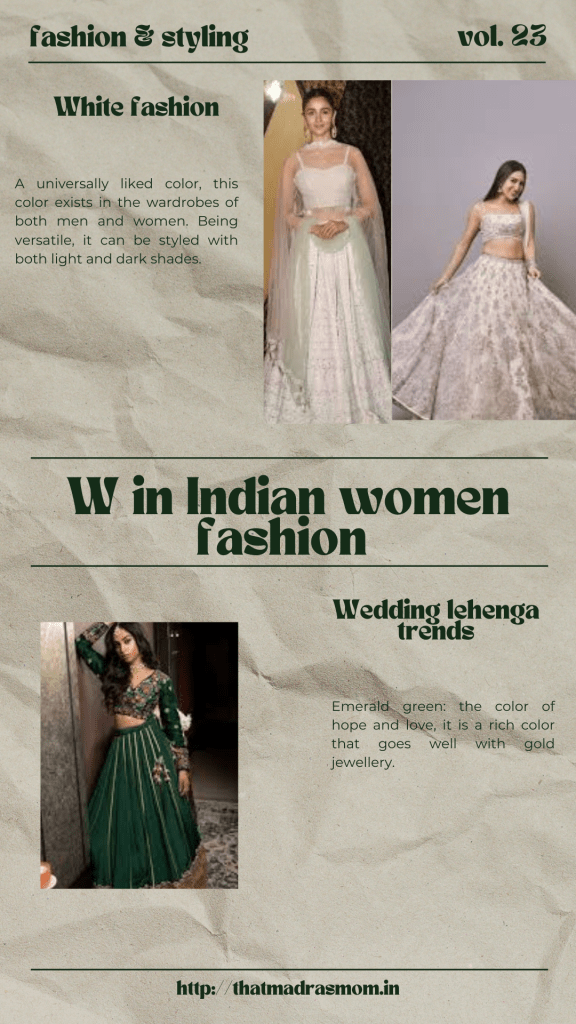
A universally liked color, this color exists in the wardrobes of both men and women. Being versatile, it can be styled with both light and dark shades. Be it weddings or cocktail parties white is a great choice for choosing your attire.
There was a season when white replaced pinks and reds.

Image source Vogue

Alia bhatt’s lehenga was the talk of the town, the white lehenga that was layered with sheer and had silver thread work caught everyone’s attention that brides to become in favor of the humble color for their choice of wedding attire.

Image source Vogue


Sara Ali Khan flaunted a lehenga choli that had floral embroidery in pink and was embellished with mirror work over white fabric that gave a grandeur look.


On that note when we talk about the trends in W, I thought I’d also give a couple of wedding trends for lehengas because we are talking about ‘W’.


Light gold lehenga: A great choice of color for lehenga that can be apt for weddings to after parties. This color will give you the versatility to pair up with any color of your choice later when you choose to reuse this outfit for any other occasion. Not only that just change the accessories and tada you are ready to rock the party and even traditional rituals.


Multicolored embroidery: These levels up the lehenga game and it gives you a different dimension. It makes your outfit extra luxurious when you play with a myriad of colors on your outfit.

Image source Pinterest


Emerald green: the color of hope and love, it is a rich color that goes well with gold jewellery.


Ombre choice: For brides who get confused if they should go for pastel shades or dark, the ombre is a great solution.


Color blocking: Gone are the days when wedding attire is monotone, the concept of color blocking is great when you want to play with shades of light and dark.

This post is part of #blogchatterA2Z 2023.

V in Indian women fashion

Timeless elegance and modern sensibilities are the fusion element in Indian women’s fashion. Indian women’s fashion has evolved over the history of 1000 years and is still adapting to the changes keeping its uniqueness.


Venkatagiri weave

Image source The Chennai silks


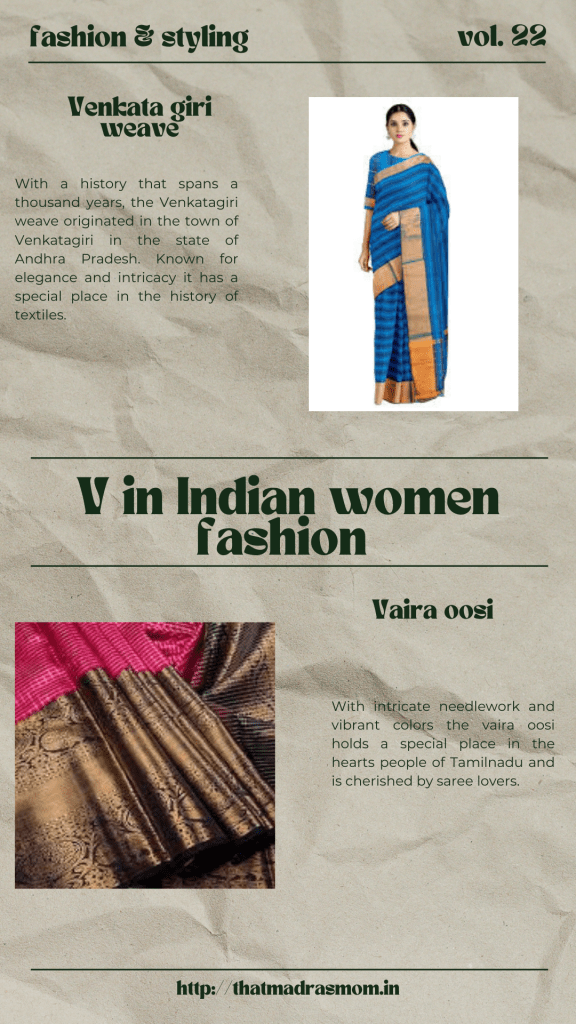
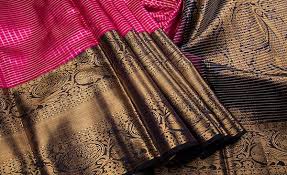
With a history that spans a thousand years, the Venkatagiri weave originated in the town of Venkatagiri in the state of Andhra Pradesh. Known for elegance and intricacy it has a special place in the history of textiles. It continues to thrive as a symbol of cultural heritage and is also loved by connoisseurs of handloom.


The fine cotton threads are woven with unique precision which is the beauty of the weave. A blueprint is initially made with a design chart which is transferred to the loom and which is woven into the fabric with cotton threads. The jamdani technique of weaving being adapted to make little motifs is the highlight here. These small motifs are done by hand mechanically and require a lot of precision with gold or silver threads which add more beauty to this weave.


The history can be traced back to the 18th century to the reign of the Venkatagiri Nayakas who were the local rulers at the time. The weavers were encouraged to weave intricate pieces for the royal court and it was a symbol of wealth and status as it became popular with the aristocratic group. It is recognized with the Geographical indication tag by the Government for its authenticity.


Vaira oosi

Image source The Palam silks


With intricate needlework and vibrant colors the vaira oosi holds a special place in the hearts people of Tamilnadu and is cherished by saree lovers. The precise intricate needlework that resembles the diamond needle brought the artwork the name, vaira oosi which literally means diamond needle.
It is mainly done on cotton and silks and the shine it brings out when light falls on the fabric is mind blowing.

This post is part of #blogchatterA2Z 2023.

S in Indian women fashion

A vibrant and diverse tapestry of culture, heritage, and style is what Indian Women’s fashion is about. The defining aspect of Indian women’s fashion is the diversity of traditional clothing that varies across geography.


Salwar Kameez

Image source Karagiri


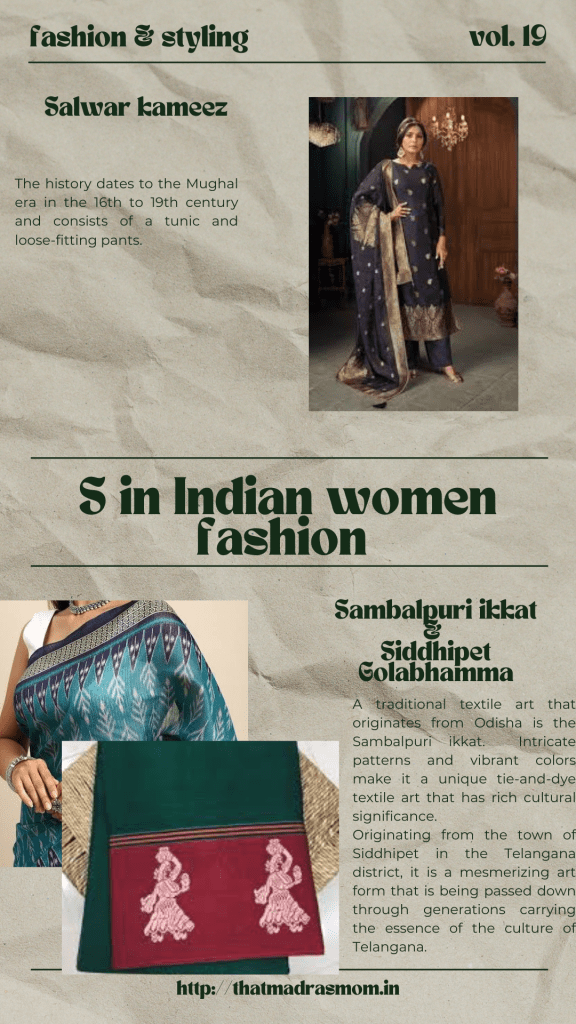
The history dates to the Mughal era in the 16th to 19th century and consists of tunic and loose-fitting pants. Often has embroideries and embellishments to make it look more elegant. Paired with a dupatta it adds a touch of elegance and can be draped across the shoulder or over the head. The comfort it offers is the key reason that most people prefer to wear the salwar kameez. It is apt for hot and humid climate because of the loose fit of the pant that allows ample movement.


It suits all body types and is versatile to be worn for any occasion. It holds significant cultural and regional significance. The same salwar kameez has different distinctions across geography. For example, in Punjab, it is of vibrant colors and in Lucknow, it has chikankari work.


Sambalpuri ikkat

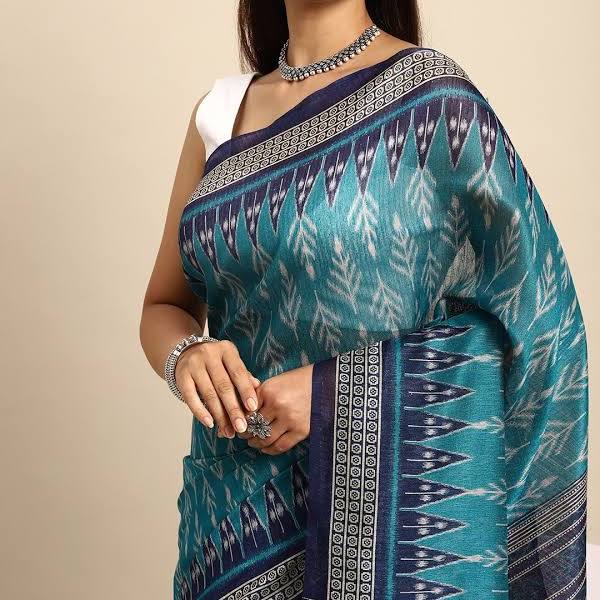
Image source myntra


A traditional textile art that originates from Odisha is the Sambalpuri ikkat. Intricate patterns and vibrant colors make it a unique tie-and-dye textile art that has rich cultural significance. It involves a complicated process of resist dyeing that is done before weaving onto the fabric. The process is labour-intensive and requires skill and precision. The intricate patterns have motifs inspired by nature, geometric designs, and symbols depicting tradition. The colors used are vibrant and are derived from natural dyes.


It has a great impact on the economy of the weaving community of Odisha, apart from being of cultural significance. The skill is passed across generations and is a form of livelihood for the people of Odisha, contributing to the socio-economic development of the state.


Siddhipet Golabhamma

Image source Pinterest


Originating from the town of Siddhipet in the Telangana district, it is a mesmerizing art form that is being passed down through generations carrying the essence of the culture of Telangana. Gola bhamma translates to round mother which signifies the round circular motifs that are characteristic of the art form. An eco-friendly and sustainable form of art, it is made using dye from plants, seeds, and minerals.


The circular motifs drawn are by freehand without any template or stencils. The patterns are eye-catching and vibrant depicting subjects from nature, folklore, and mythology.

This post is part of #blogchatterA2Z 2023.

Q in Indian women fashion

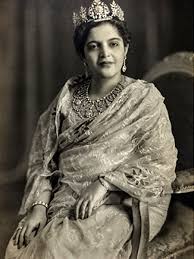
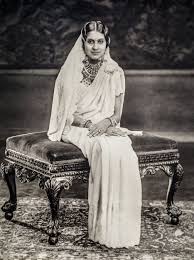
Indian women’s fashion influences are not only by seeing movie stars but going back in history to the period of the Maharanis(Queens) and the princesses. The invasion of the Indian subcontinent by people from far-off places has influenced women’s fashion trends that have become timeless. Though we could say the fashion world is still evolving, yesteryear trends continue to rule the world of fashion.


The influences involved rich and intricate designs on the luxurious Indian fabrics and jewellery trends that remain classic. Indian Royalty has played a major role in setting the benchmarks for fashion trends. Rajkumaris and Maharani’s have shown how to be stylish and elegant.


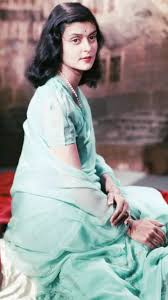
Maharani Gayatri Devi

Image source Times of India


The third Maharani consort of Jaipur, Maharani Gayatri Devi, married to Maharaja Sawai Man Singh II, was known for her love for pearl necklaces, bob cuts, and chiffon sarees. Named by Prestigious Vogue magazine in the list of 10 most beautiful women in the world. Her love for chiffon sarees in pastel hues still stands timeless as it is preferred by women even today. She proved that chiffon sarees with pearl strings make stronger fashion influences than benarasi sarees. Her long-sleeved blouses are still a hit when paired with sarees.


Maharani Tara Devi

Image source Facebook


The pantsuit, with tie and hat, set a new style statement and proved us wrong that Tailored suits came into fashion in the 21st century. A skilled hunter, she was a pioneer in fashion trends introduced by the Maharanis.


Maharani Indra Raje

Image source Wikipedia


Known for her collection of fine silks and neckpieces, it is believed that she was the first to catch the sight of chiffon and was asked to extend the length up to 42 inches to drape as a saree. Her fine taste in fashion was evident from her collection of sarees and neckpieces. Mother of Maharani Gayatri Devi, we now know how the latter got her fashion sense inspired by her mother.


Princess Rafat Zamani Begum of Rampur

Image source Wikipedia


We all thought that the mathapatti trended after we saw Alia flaunting them on her day of marriage, but the Princess brought the trend 60 years back. Known for her heavily embellished lehenga which included beads, diamonds, and even found on her dupatta. The lehenga also had floral motifs which were studded with diamonds. She even wore a diamond tiara.


Maharani Yashoda Devi of Patiala

Image source Facebook


The Maharani adored a ruby choker which is a classic in the field of Jewelry design that was done by Cartier in 1931 and gifted to her by Maharaja Bhupinder Singh of Patiala. The magnificent piece had six layers of ruby studded with diamonds and pearls on the sides.

This post is part of #blogchatterA2Z 2023.

I in Indian women fashion

The Indian fashion industry not only comes up with new ideas but also revives traditional wear by adopting techniques in cuts and giving the outfit a new dimension. The weaves from yesteryear are great fabrics for modern wear today.


Let us look at trends in I.


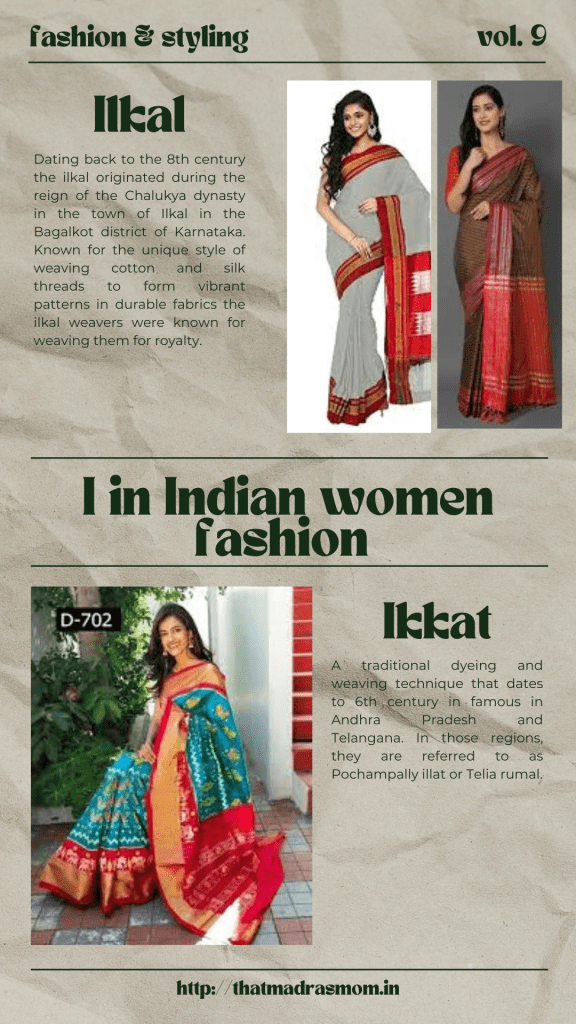
Ilkal weave

Image source Amazon


Dating back to the 8th century the ilkal originated during the reign of the Chalukya dynasty in the town of Ilkal in the Bagalkot district of Karnataka. Known for the unique style of weaving cotton and silk threads to form vibrant patterns in durable fabrics the ilkal weavers were known for weaving them for royalty.


The garment had intricate designs and patterns, which followed the ilkal weave evolving by incorporating elements from neighboring regions. Temple silk is the special yarn that is used for weaving which gives stiffness and makes it easier to weave. The pit loom allows the weaving of complex patterns and designs which makes it unique.


Bright and bold colors like red, green, and gold are predominantly used for ilkal weaving. The weaving is a time-consuming process that begins with the preparation of the yarn. The cotton and silk threads are prepared separately, wherein silk is treated with starch to get stiffness. The two threads are then weaved together through weft and warp techniques in the pit loom.


The resulting Ilkal fabric is durable and is resistant to wear and tear. The fabric is also known to retain color and shape therefore has a long life and is one of the reasons that it is most sought-after.


As long as there are skilled ilkal weavers, it will continue to thrive and mesmerize us with its vibrant beauty. Ilkal sarees are passed across generations as family heirlooms.

Ikkat

Image source Indiamart


A traditional dyeing and weaving technique that dates to the 6th century is famous in Andhra Pradesh and Telangana. In those regions, they are referred to as Pochampally illat or Telia rumal.


They are majorly known for their vibrant colors, intricate designs, and durability. A time-consuming and labor-intensive method, the weaving involves preparing yarn by tying and wrapping them in resist like mud or wax for patterns, post which they are dipped in dye. The resist is then removed and the thread is sent into the loom to be woven into a vibrant fabric.


It’s a unique look where the pattern looks like it is woven into the fabric unlike others that look printed on the fabric making it stand apart from its counterparts. Initially used for sarees the ikkat is now part of a lot of garments like salwar, jumpsuits, and even furnishings like table runners and curtains.


Owing to the time consumption and skilled craftsmanship the cost is a bit on the higher side. The ikkat dyeing has now also been done on silk which gives the sarees a grandeur looks with the intricate patterns and vibrant colors.

When we discuss trends in I, we can also mention Indo-western dresses which is nothing but the fusion wear we discussed while discussing trends in F which can be read here.

This post is part of #blogchatterA2Z 2023.

E’ s in Indian women fashion

An essential part of the country’s rich cultural heritage especially when keeping in mind fashion, ethnic wear, and jewelry are things that hit the chord. Especially in a diverse country like India which has a rich cultural history you are limitless with the options you have when it comes to dressing up and following it up with accessories. Let us look at some of the famous ethnic dresses and jewelry in Indian women’s fashion.


When you turn back and look you may notice a wide range of styles, patterns, and designs when it comes to ethnic wear. Be it the fabric, the craftsmanship involved in weaving, the type of occasion whatsoever, you name it, and Tada! You have a dress and a matching accessory. Snap and which land are you in? Well, the answer can be said out loud beaming with pride that it’s India.


From Sarees, salwars, kurtas, lehengas, and half sarees Indian ethnic wear for women has a never-ending list of options. Each of these has a unique charm and adds beauty to the person who wears it.


Saree

Image source pixabay


The saree is a long piece of fabric that is draped around the body and paired with a blouse. Depending upon the place of living, and type of occasion the saree is available in a variety of materials and there is one for everyone. There are silk sarees for weddings, cotton sarees for everyday wear, and georgette sarees for a party. Embellished with sequins or stones the sarees are made to look more grandeur.

Pairing them with different blouses ranging from halter necks to tank tops gives you a truckload of options for fusion wear. Leave the blouse pairing, the type of drape is a whole new chapter that will give you ideas to drape the same saree in about 20+ styles without making people guess that you’re wearing the same thing over and over again.

Wait, and don’t worry if you can’t get the drape right, we Indian women have a solution even for that. We now have businesses that sell one-minute sarees. You just must clip and swish two rounds and be done. You will look like someone who hired a professional to drape your saree. It all becomes so easy that you only have to choose the saree, give them your measurements, and in two days land your Cinderella costume. And for a bonus, some of them even come with customized blouses how cool is that? And if your curves give you insecurity worry not, you have saree shapewear that literally will make you go unrecognizable.

Salwar kameez


A tunic paired with loose-fitting pants makes it a breezy garment. Most women resort to this for everyday wear. It comes in a variety of fabrics and different stitching styles. This can be paired with a dupatta or even a scarf.


Lehenga

Image source pixabay


Predominantly worn for special occasions like weddings, the lehenga is a long skirt paired with a blouse and a dupatta. It can be elegant and luxurious at the same time depending upon the fabric and the amount of handwork that goes into making it. Silk and luxurious fabrics are the most sought materials for a lehenga which is then embellished with stones and sequins.

Ethnic jewellery


An essential part of Indian ethnic wear and no garment is complete without pairing it with jewelry.


The usage of precious metals, intricate designs, and skilful craftsmanship in Indian jewelry is very famous throughout the world. The jewelry includes earrings, bangles, chains, necklaces, rings, toe rings , maang tikkas and anklets.

Image source pixabay


A kundan set that includes earrings, a necklace, and a maang tikka is one of the most famous jewelry forms. Glass stones that are set in gold or silver metal base make it look classy and regal.

Image source Indiamart


A polki set is something similar to kundan except that instead of glass stones, this has diamonds studded, which makes it a perfect wear for special grandeur occasions like weddings. Polki sets are expensive and luxurious forms of Indian jewelry.


Indian women love to wear bangles which are like bracelets that can be made in gold, silver, glass, and lac. They come in a variety of colors and intricate patterns on them can be made to make them look grand.


Indian women also love layering up jewelry. With Short necklaces and long chains, they have a variety of options to style up depending on the neckline of the outfit they wear.
Ethnic wear dresses and jewelry reflect the diversity of our country and its rich cultural history. Indian ethnic wear is loved by women across borders and is cherished by people across the world. Indian women’s fashion is timeless, truly unique, and elegant in its own way.

This post is part of #blogchatterA2Z 2023.

D’s in Indian women fashion

Weddings, festivals, or everyday wear, Indian women’s fashion is an important part of the country’s cultural heritage. From attire to accessories, we can say it is a dynamic industry. Let us look at fashion in D.


Dhoti pants

Image source Amazon

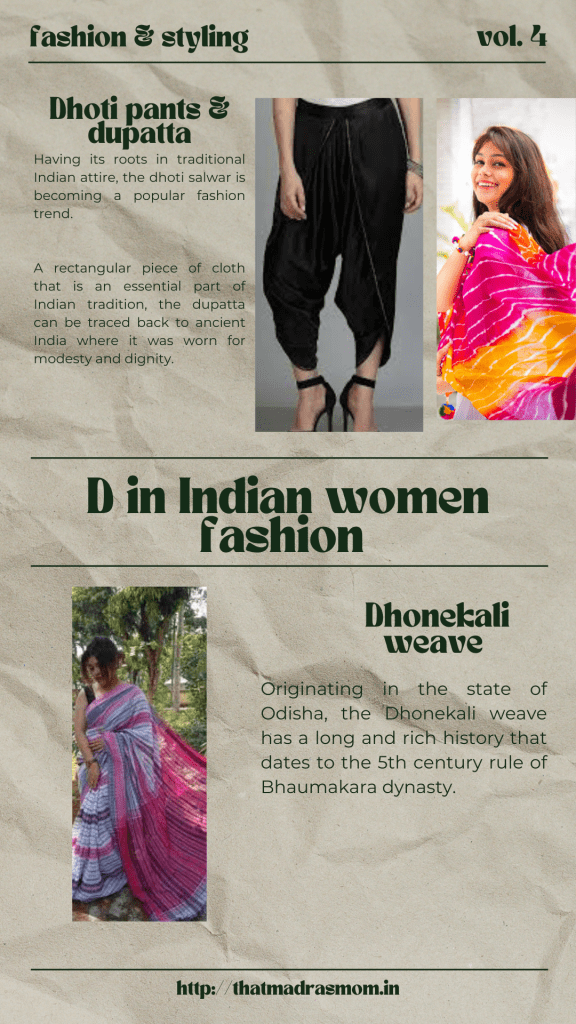
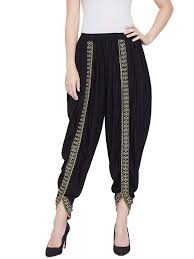
Having its roots in traditional Indian attire, the dhoti salwar is becoming a popular fashion trend. Honoring the cultural heritage but also wanting to have a chic and trendy look, fashion-conscious women have found a way to interpret traditional attire.


Typically worn by men in India, across centuries the dhoti is everyday wear but also makes its way to weddings depending on the fabric with which it is draped. Combining the comfort and fluidity of dhoti but maintaining the structure of a pant, the dhoti pants for women is undoubtedly one of the most versatile garments ever. With an elasticated waistband, it is suited for all body types and can be made in silk, linen, or cotton with vibrant colors and intricate patterns.


Its versatility is boundless that you can pair it with a t-shirt or tank top for a casual look, a kurta, and a heel for a formal look which makes it great for fusion wear. The loose and airy fit is great for the humid climate and makes it easy to move which makes it a great comfort wear.


It can also be layered with a jacket and sweaters with scarves to be worn during winter. So typically, the dhoti pants can be worn all through the year, depending on how you pair them with.


Dupatta

Image source Amazon


A rectangular piece of cloth that is an essential part of Indian tradition, the dupatta can be traced back to ancient India where it was worn for modesty and dignity. Elders considered it as a mark of respect when women wore it over their heads. It also gives an aesthetic appeal and is made from cotton, chiffon, silk, and georgette with intricate patterns embellished with stones and embroidery.


It is an essential component for most Indian attires like salwar, lehenga, and even sarees. It can be draped over the head, or the shoulders and sometimes even as a veil covering the face. While silk dupattas are reserved for weddings, cotton is preferred for everyday wear. It can be plain for everyday wear or embellished with stones or embroidery to give a touch of elegance.


Dhonekali weave

Image source meesho


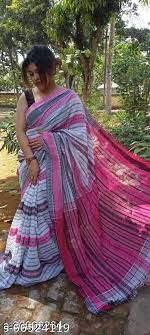
Originating in the state of Odisha, the Dhonekali weave has a long and rich history that dates to the 5th century rule of Bhaumakara dynasty. Typically used to weave garments for weddings like saree for women and dhoti for men, the dhonekali is a technique that has a distinctive pattern.


Being passed down through generations the weave uses a hand-operated loom and uses a technique called dobby, which involves dobby bars which are wooden sticks to make intricate patterns. It also uses a special yarn katki which is twisted to create a stronger yarn and then dyed with colors to make intricate patterns.


An important part of Odisha’s cultural heritage, it is also a symbol of prestige and status, since it was worn during ceremonies. Not only garments, the weave also found its place in temples as prayer mats and wall hangings.

This post is part of #BlogchatterA2Z 2023.

B’s in Indian women fashion


Talking about India’s rich history of women’s fashion, which dates back centuries, the vibrant prints and weaves that originated from small villages still stand leading their way on top of the most sought-after weaves. Not only popular within the Indian subcontinent, but some of these weaves are also considered souvenirs by tourists from across the globe.
Let us look at some of the Indian women’s fashion trends in B.


Bandhani

Image source meesho


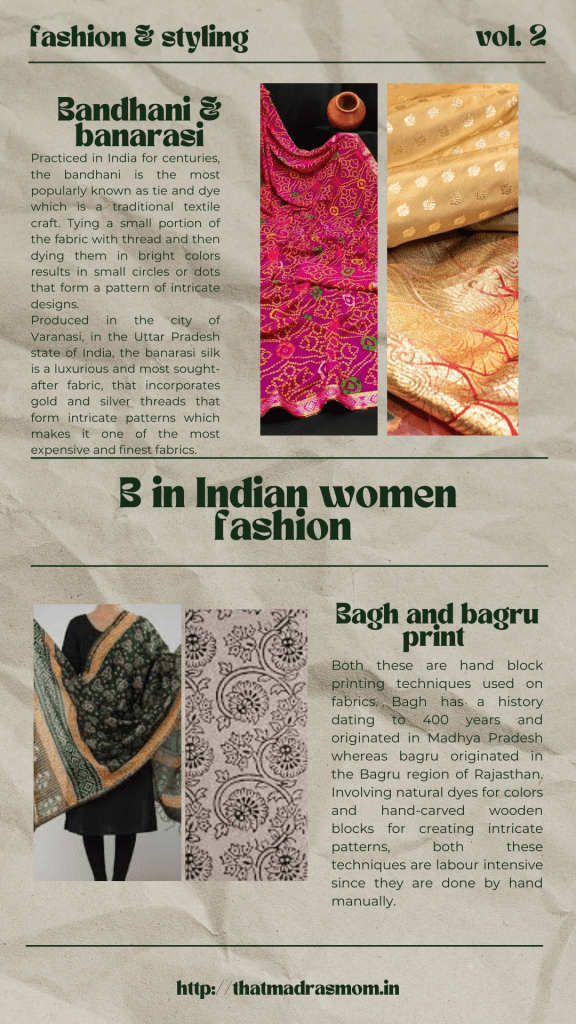
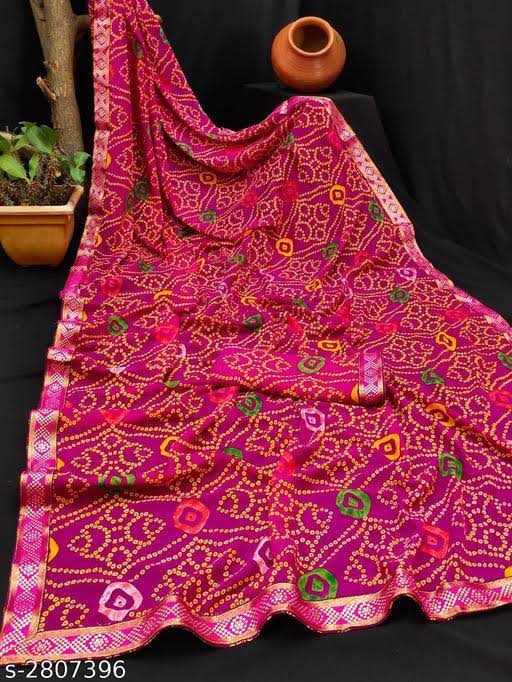
Practiced in India for centuries, the bandhani is the most popularly known as tie and dye which is a traditional textile craft. Tying a small portion of the fabric with thread and then dying them in bright colors results in small circles or dots that form a pattern of intricate designs.
Though Bandhani originated in the state of Gujarat, it is also being practiced in the neighbouring state of Rajasthan. The art of this weave has been passed along through generations and is one of the ways of earning an income. Traditional techniques and natural dyes are still being used for bandhani by many families in Rajasthan and Gujarat.


The unique patterns of dots, stripes, and waves which result in an intricate pattern often vary across the different regions in which this art is practiced. The bright and bold colors used reflect the mood of the occasion for which the fabric would be worn and often vary across geographies and availability of various natural dyes.


Requiring patience, precision, and creativity the bandhani is a highly-skilled craft, which is quite labor-intensive since each dot or circle is individually tied before being dipped in the dye obtained from plants and animals.
The beautiful and intricate textile craft of bandhani which reflects the cultural heritage of India is not only popular in India but also has a fanbase across the world. Designs incorporate modern twists to this ancient craft to adapt to contemporary fashion.


Banarasi silk


Produced in the city of Varanasi, in the Uttar Pradesh state of India, the banarasi silk is a luxurious and most sought-after fabric, that incorporates gold and silver threads that form intricate patterns which makes it one of the most expensive and finest fabrics.


Dating back to Mughal era, where Persian artisans were brought to Varanasi to create weaves for the royal court. The craft evolved over time, with the artisans incorporating local designs and motifs into the fabric. The fine quality, rich texture, and intricate designs make it highly prized among consumers.
The finest silk threads are woven in hand-operated looms which are enhanced using gold and silver threads that give the fabric more shine and luster. From floral motifs to geometric shapes, the threads are intricately woven to obtain desired patterns. Brocade, Zari, and meenakari techniques are used to weave into the banarasi fabric. Used to make traditional Indian costumes like sarees, salwar, and lehengas the banarasi silk is also used to make luxurious shawls and scarves. Often banarasi sarees are passed down as family heirlooms. The fabric is recognized as a geographical Indication(GI) by the Indian Government, which helps in protecting the unique identity of the product and prevents duplicates from being sold in the market.


Bagh and bagru prints

Image source itokri
Image source Amazon


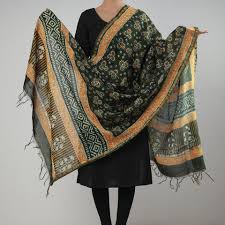
Both these are hand block printing techniques used on fabrics. Bagh has a history dating to 400 years and originated in Madhya Pradesh whereas bagru originated in the Bagru region of Rajasthan. Involving natural dyes for colors and hand-carved wooden blocks for creating intricate patterns, both these techniques are labour intensive since they are done by hand manually.


Once printing is complete, the fabrics are washed to remove excess dyes and fixatives.  The vibrant colors and intricate design on the bagh and bagru print fabrics are inspired by nature and traditional motifs. Both are eco-friendly and sustainable processes that make them a one-of-a-kind fabric.

This post is a part of #blogchatterA2Z 2023.

A’s in Indian women fashion

Dating back centuries, Indian Women’s fashion has a rich history. Be it the intricate designs, vibrant prints, or magnificent weaves, Indian women’s fashion is still evolving and offers a diversified range of styles and trends.
Beginning with A, I decided to pick out two styles and two weaves to discuss Indian Women’s fashion.


Anarkali and Angrakha


Being around for centuries, Anarkalis and Angrakhas are traditional attire with a rich history and are still in the limelight of contemporary fashion. Having been worn for special occasions like weddings and festivals to now being part of fusion wear, these Indian attires are not going anywhere out of trend.

Image source: Yash gallery


Anarkali, a long flowing dress was named after Anarkali, a famous dancer, and courtesan, who wore this attire when she performed for Emperor Akbar. It is said to have originated in the 16th century during the reign of the Mughals. Flaring out from the waist with a fitted bodice extending to the hips, the Anarkali attire is made of silk. Heavily embellished with sequins and embroidery on the bodice, the sleeves of an Anarkali can either be long or short and are usually made of sheer. It can be worn with a dupatta or as a dress in itself with just a scarf to accessorize or layer.

Image source : myntra


The Angrakha on the other hand, originated in the 18th century in Gujarat and Rajasthan. It was typically designed for men but was later adapted for women as well. Like Anarkali, the angrakha is a flowing skirt that flares from the waist but has a shorter bodice with a slit in the front. It’s usually made with light flowy fabrics like cotton and silk and often embellished with embroidery and vibrant prints for a grandeur look.


Both garments are worn during special occasions such as weddings, festivals, and religious occasions and do have a rich cultural and historical significance of their origin. They’ve become popular choices in contemporary fashion to be worn for formal occasions. Designers have also come up with modern twists making them into fusion wear, wherein the Anarkali can be worn as a floor-length gown and the angrakha is designed with unconventional prints and asymmetric hemline.


These attires have stood the test of time, and women wear them to be in connection with their heritage. Designers have adapted modern tastes giving twists to the attire in contemporary fashion.
This also is proof that these attire will remain popular for years to come and are timeless treasures.


Ajrakh and Arani silk


Known for their intricate designs and high-quality material, the Arani silk and Ajrakh prints are traditional Indian textiles that have been passed down for generations.

Image source : pixabay


Traditionally made, the ajrakh is a type of hand-block printed fabric from Kutch in Gujarat and Sindh in Pakistan. The fabric has been worn by generations of people in that region which dates to 4000 years. Cotton and silk fabrics are dyed with natural colors like indigo and Mudder and printed with intricate designs. It is then washed and dried a couple of times to achieve the desired pattern and color. The result is a fabric known for intricate geometric patterns and vibrant colors.


Considered a symbol of the wearer’s heritage the ajrakh fabric is often worn for weddings and religious occasions. The fabric has a deep cultural significance in the area it is produced. Sometimes used as a traditional remedy for certain ailments, the ajrakh is also believed to have healing properties.

Image source : meesho


Arani silk originates from the town of Arani in Tamil Nādu. Known for its high-quality and durability, it is used to make sarees and traditional attires. ‘Rehwa’, a process that involves twisting two threads to form a stronger, durable fabric is used in weaving the arani silk. The result is a fabric known for its lustre and softness.


Highly sought after for their beauty and quality, the arani silk sarees are worn during weddings, and religious occasions and are even passed along through generations as family heirlooms. Being produced in the Arani town for centuries it is a major part of the local economy.


Ajrakh and Arani are important in India’s rich textile heritage. Produced using traditional techniques they have been passed along through generations to keep the art of weaving along. Often worn during important occasions like weddings, both have been deeply rooted in the cultural heritage of the region of their origin. Prized for their beauty and cultural significance be it the lustrous beauty of Arani silk or the intricate patterns of Ajrakh, people around the world continue to be captivated.

This post is a part of #BlogchatterA2Z 2023.