
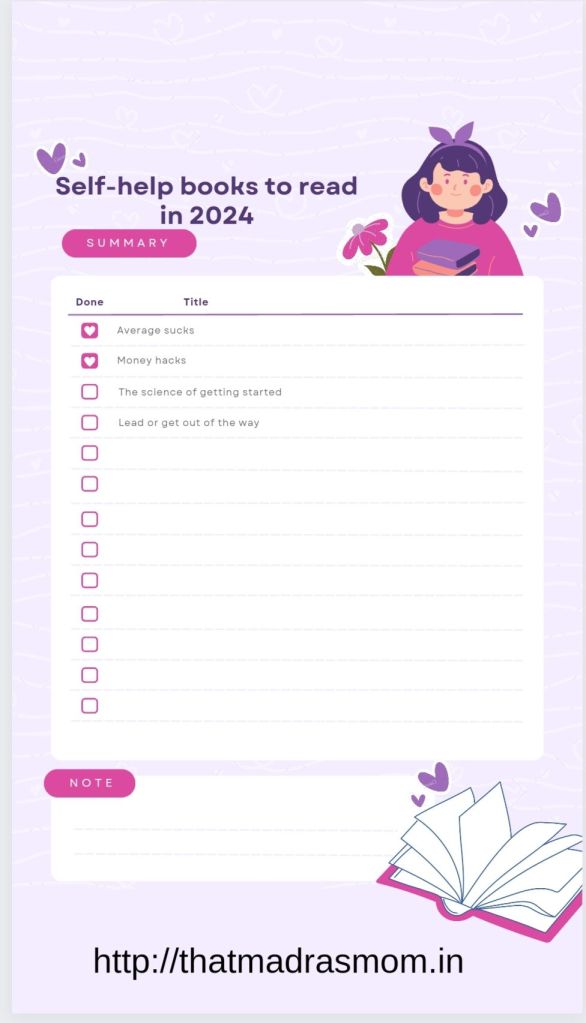
Self-help books to read in 2024

Self-help has always been one genre that keeps me glued while reading. I look forward to books that have a tone that is practical and not something preachy. I choose books which have a good amount of examples, case studies and research based evidence which is a sign that the book needs to be added to my TBR. Here are a few books that made it to my reading list.

Average sucks by Michael Bernoff

A book that challenges you to come out of your comfort zone and unleash your true potential. The reason we don’t get what we want is that we have an average that defines the behavior, performance, and results. This is the reason that the book argues. Our average is the invisible force that keeps us stuck in mediocrity and prevents us from achieving our goals. It shows how to identify our average, raise it, and surpass it so that we create an extraordinary life.
It is not a typical self-help that gives generic advice but rather a powerful guide that teaches how to change mindset, habits, and actions. The author has used these tools and techniques with thousands of clients.

The book has three sections such as
PART 1: The problem– Explain what your average is. How it affects you and why it hurts.
PART 2: The solution– reveals the five steps to raising your average and creating a lasting change.
PART 3: The action– provides exercises, challenges, and resources to help in implementing the solution and transforming your life.


A suitable book for anyone who wants to improve any area in their life- personal, professional, and social. I realized how my average was holding me back from achieving my dreams. I found a lot of tools and strategies to raise my average to create more happiness and success. A good guide that teaches you how to live an above-average life.Read a short review here. Buy a copy.

Money hacks by Larry Steinhouse

A book that reveals the secrets of money and how to use it to your advantage, it also challenges the common myths and misconceptions about money. The book shows you how to think differently and creatively based on your financial solution. I loved the topics that the book covered such as,

  • How to obtain huge lines of credit while building up credit scores and your net worth.
  • How to negotiate better deals and save money on everything you buy.
  • How to avoid pitfalls and traps of debt, taxes, and inflation.
  • How to develop a money mindset that attracts wealth and abundance.


The book is written in a simple, conversational, and humorous style with stories, tips, and real-life examples from the author’s own experience as a successful real investor and entrepreneur. The book is suitable for anyone who wants to learn more about money and how to make it work for them. It is not a get-rich scheme but a realistic guide that teaches the skills and strategies you need to achieve your financial goals. The book opened my eyes to the possibilities and opportunities that money can offer and how I can use it to create more happiness and security in my life.


I found a lot of tools and techniques that can be applied to my situation. A realistic guide which can help anyone understand the truth about money and how to use it smartly. Read a short review here. Buy a copy.

The Science of getting started by Patrick King

A book that explores the psychological and biological reasons why we procrastinate and how to overcome them. It reveals the hidden forces that prevent you from taking action such as perfectionism, fear, impulsiveness, self-doubt, and boredom. It also provides practical and proven strategies to help start and finish any task, goal, or project.

  • How to use the power of habits and routines to automate your productivity.
  • How to leverage the psychology of motivation and rewards to boost your performance.
  • How to apply the principles of behavioral economics, neuroscience, and game theory to make your work more fun and engaging.
  • How to overcome the common excuses that keep you stuck.
  • How to deal with distractions and interruptions.
  • How to cope with stress, anxiety, and fatigue which can sabotage your progress.


Written in a clear, concise, and conversational style, with case studies, personal anecdotes, and scientific research that support the author’s points the book is not a boring text but an entertaining lively guide that teaches skills on how to master the mind and take action.

This book is suitable for anyone who wants to improve their productivity, efficiency, and effectiveness in any area of life. The book was very helpful and an insightful read which helped me understand how I procrastinate and how I can change it. A lot of tips and techniques can help boost my productivity and achieve my goals. I can say that it is a science-based solution to getting started. Read a short review here. Buy a copy.

Lead or get out of the way by Gary .J.Vien

Lead or Get Out of the Way is a practical and inspiring book that lets you know how to become an effective leader. And if you are already one, this book will help you become much more effective. Based on his forty-year career in the military, education, government, and business as a leader, the author presents 8 principles of leadership that help in achieving your goals, overcoming challenges, and influencing others.


With clear examples, tips, and exercises these 8 principles are explained in detail for us to apply in our situations.

The principles are:

  • Communicate effectively.
  • Build trust and credibility.
  • Know yourself and your purpose.
  • Lead by example.
  • Collaborate and partner.
  • Empower others.
  • Embrace change and innovation.
  • Celebrate success and learn from failure.

A good handbook that lets you assess the leadership skills currently and find out areas for improvement. Written in a simple and engaging style, with a pinch of wisdom, insight, and humor, it is a book that is apt for anyone who wants to improve their leadership skills, irrespective of whether they are people who aspire to be leaders or new and experienced leaders.
A helpful and motivating read, the book gives practical tools and strategies to enhance leadership abilities and confidence. Making me think about how to make an impact on others and to think differently is what the book made me gain.

These books help understand what actually is happening and analyse situations. They also guide you on how to handle situations by giving you the knowledge about tools and techniques which will help you arrive at solutions. Read a short review here.  Buy a copy.

This blog post is part of the blog challenge ‘Blogaberry Dazzle’ hosted by Cindy D’Silva and Noor Anand Chawla in collaboration with the Bohemian Bibliophile.

5 reasons why we procrastinate and how to overcome it

“Don’t put off until tomorrow what you can do today.” – Benjamin Franklin


An act of unnecessarily postponing things , decisions or actions is called procrastination. People often confuse this with laziness but both are very different in their own ways.


Procrastinating is active meaning you chose to do something else instead of the actual task that you are supposed to be doing. Laziness on the other hand is being inactive and not deciding to do anything at all.


Procrastination is usually ignoring an important task in favour to something else that is much more easier to complete. Minor instances of procrastination can make us pay a heavy price. So it is always better not to give in to it, even if it is a smaller instance.

Primary issues cropping up would be demotivated behavior leading to low performance. But if it continues in the longer run it might lead to depression due to accumulated stress and degrade physical and mental health.

Most often misinterpreted as a matter of willpower, people fail to recognize that procrastination is something much more complex. Self-control is most important to give us the push to complete a task. We often get demotivated when factors like anxiety,negativity, failure interfere with self-control and take us in the opposite direction away from motivation.

Exhaustion and delay in receiving the reward for completion of task may make you disregard the value of the reward which interferes with the self-control and motivation. We must keep in mind that both self-control and motivation work hand-in-hand for us to complete a task or do an action. Anything in interference to these two will definitely have a negative impact.

Why do we procrastinate?


Unclear or abstract goals


When you have a concrete goal that is clearly defined you are more likely to show greater interest in completing the steps to achieve it. Contrary to this if your goal that is set is abstract or vague you are more likely to procrastinate.


Late rewards


When tasks come with the late reward package you are likely to deem it unimportant because the reward is getting to you a little late. Delay discounting where people tend to discount the value of rewards that they would be receiving later crops up. So people become biased to tasks which offer them a reward earlier and would be much interested to complete it first even if it is not critical.


Disconnect with future


A disconnect between the present and the future individual known as temporal discontinuity causes procrastination. People become carefree that the present is the only time to be concentrated and the future can be handled when it comes with the flow.


For someone who is advised a healthy diet by the physician failing to do so because, it is only the future individual who will be the sufferer. They fail to realize it is the individual’s present eating lifestyle that would cause the problems in future.


Optimistic future


People procrastinate because they are optimistic about the completion of tasks in future given the fact that they are confident of the availability of time and their ability to complete. Most often they fail when it comes to calculate the inadequate time at their disposal to complete the task and console themselves by saying the next time it would be different if in case it is a repetitive task.


Inability to make decisions


People procrastinate in situations when they are unable to decide the next course of action. Given the fact that the options in front of them would be too many to choose from, too important to choose and too similar to choose. In such cases the individual is said to have indecisiveness to proceed.


Anxiety and being overwhelmed


Sometimes when people feel anxious and highly overwhelmed they tend to procrastinate. Overwhelming could be due to situations where there is a single huge task or a couple of simple tasks. Anxiety on the other hand will have the capability even to put this into a loop- Anxiety and procrastinating due to anxiety.


Fear of failure, evaluation and negative feedback.


Exaggerated and unjustified would be right to name the fears in most cases when people procrastinate. The fear of being evaluated and given a feedback from the public make people worry and end up in procrastination.


Fear of failure is another important factor that plays a major role and could also be considered a subset of the evaluation and feedback fear. This would make them continue to work and not come to completion because of the fear.


How to overcome procrastination?

Agree or identify that you are procrastinating

The first step is to Identify that you’re into procrastination. Most people fail to recognize that they are procrastinating and think what’s stopping them.

How do you identify?

  • Waiting for the right time to work on it or make decisions.Read the instructions again and again but not taking any action or devising a strategy to work.
  • Low priority tasks are filled for the entire day in your planner.
  • Putting off a task in to-do for a long time though you know its important.
  • Try to fix why you are procrastinating.


Most times it is because of the task that is presented if it is vague or too simple or is overwhelming to be completed. Not having a proper strategy or the fear of success and failure could make you procrastinate. So identify the why and try to fix it.


Stopping the habit of procrastinating by adopting anti-procrastinating strategies.


If its an old habit it takes time to die hard. So understand that you cannot overcome this overnight. It takes time to forget the habit. Think how you could adopt strategies that will help you not procrastinate.

Strategies that help overcome procrastination

  • Forget the past.
  • Self-rewarding
  • Be capable of taking decisions immediately rather than postponing.
  • Peer pressure works so have someone check on you.
  • Commitment to the task
  • Lessen or minimize the distraction
  • Act on the go.


Take more control on the task. Think of it in a way that you choose to complete rather than you need to or you have to.


Procrastination is not a disease. It is not late to start correcting it, even if you are a senior citizen. Everybody gets a chance make mistakes, learn and bounce back. Make sure you do not procrastinate to getting started on the way to stop procrastinating.

This post is a part of Blogchatter Half Marathon.’ 

COPYRIGHT NOTICE –
@Sindhu Vinod Narayan. Unauthorized use and/or duplication of this material without express and written permission from this site’s author and/or owner is strictly prohibited. Excerpts and links used, provided that full and clear credit is given to Sindhu Vinod Narayan (Thatmadrasmom) with the right and specific direction to the original content.

This post is part of #causeachatter for blogchatter